
Exploring the Future of AR/VR: Market Insights into Augmented and Virtual Reality Applications
As immersive technologies become more accessible and advanced, Augmented Reality (AR) and Virtual Reality (VR) are finding applications across sectors from education and healthcare to gaming, tourism, and retail. These technologies are not only transforming user experiences but also enhancing productivity, engagement, and learning outcomes. In this blog, we explore how the AR/VR landscape is evolving, based on 2024 market sizes and forecast growth rates through 2034.
Market Size and Growth Comparison
The AR/VR market is composed of both established and emerging segments, showing a wide range of market maturity and growth potential.
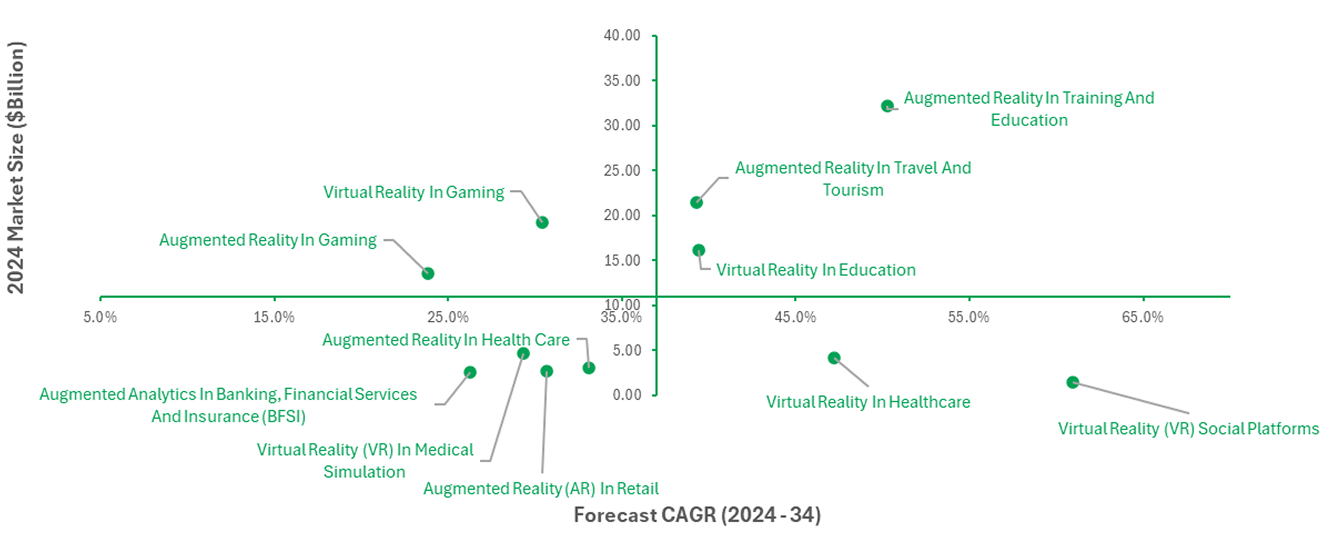
Based on current data, we can group the segments into the following categories:
1. High Growth, Large Market Size
- These markets are expanding quickly and already command substantial value.
- Augmented Reality in Training and Education ($32.2B, 50.3% CAGR): Driven by immersive skill training, onboarding, and virtual labs, this segment is helping organizations upskill employees and students in more engaging ways.
- Augmented Reality in Travel and Tourism ($21.4B, 39.3% CAGR): Destinations and travel apps are offering AR-based tours, overlays, and previews, enhancing visitor experiences and marketing.
- Virtual Reality in Education ($16.1B, 39.4% CAGR): With virtual classrooms and experiential learning becoming mainstream, VR is changing the face of remote education.
2. High Growth, Moderate Market Size
- These are emerging markets that are growing rapidly but currently have a modest market value.
- Virtual Reality in Healthcare ($4.2B, 47.2% CAGR): Use cases include pain management, post-traumatic therapy, surgical planning, and virtual therapy sessions.
- Virtual Reality (VR) Social Platforms ($1.5B, 60.9% CAGR): The metaverse vision has spurred investments in immersive digital communities, driving fast growth.
3. Stable Growth, Large Market Size
- Segments in this category are well-established and continue to grow at a steady pace.
- Virtual Reality in Gaming ($19.2B, 30.4% CAGR): VR gaming continues to lead in consumer adoption, supported by improvements in headsets, consoles, and content.
- Augmented Reality in Gaming ($13.6B, 23.8% CAGR): AR gaming remains popular on mobile platforms, with apps using geo-location and real-world overlays.
4. Lower Growth, Moderate Market Size
- Augmented Reality in Health Care ($3.05B, 33.1% CAGR): AR assists doctors in surgery navigation, diagnosis visualization, and real-time medical information access.
- Augmented Reality (AR) in Retail ($2.68B, 30.7% CAGR): Brands are using AR for virtual try-ons, product demos, and personalized in-store promotions.
- Virtual Reality (VR) in Medical Simulation ($4.7B, 29.3% CAGR): This is aiding medical professionals with realistic, repeatable, and risk-free training simulations.
- Augmented Analytics in BFSI ($2.6B, 26.3% CAGR): Financial institutions are leveraging AR/VR dashboards for real-time analytics, fraud detection, and training.
Explore our comprehensive market reports in the AR and VR industry
Segment Insights

Augmented Reality in Training and Education
AR is transforming how students and employees learn by offering interactive, hands-on training experiences without the risks or costs of real-world practice. From virtual welding simulations to anatomy overlays in medical education, AR enhances knowledge retention and skill acquisition.

Augmented Reality in Travel and Tourism
AR applications in tourism are enriching travel experiences through historical overlays, real-time translations, and immersive museum guides. These tools help travelers engage more deeply with destinations and improve accessibility for international audiences.

Virtual Reality in Education
VR-powered classrooms offer fully immersive experiences—students can walk through ancient ruins, explore planetary systems, or conduct virtual science experiments. This approach improves student engagement, especially in STEM subjects, and supports remote learning models.

Virtual Reality in Healthcare
VR is playing a vital role in pain distraction therapy, PTSD treatment, and surgical planning. Hospitals use VR to reduce pre-operative anxiety in patients and to offer cognitive behavioral therapy (CBT) in safe, repeatable environments.

Virtual Reality (VR) Social Platforms
These platforms are the backbone of the emerging metaverse. Users create avatars, attend events, play games, and socialize in fully 3D environments. As hardware becomes more affordable, mainstream adoption is expected to rise sharply.

Augmented Reality in Health Care
Surgeons and clinicians use AR glasses to visualize patient anatomy in real time during operations. AR also supports remote collaboration, enabling specialists to guide procedures from different locations, improving healthcare delivery in underserved areas.

Augmented Reality in Retail
AR apps allow consumers to “try before they buy” — testing furniture in their living rooms or makeup on their faces. This reduces return rates, boosts conversion, and enhances personalization, making it a go-to tool for omnichannel retail strategies.

Virtual Reality in Medical Simulation
Training with VR simulators helps medical students and professionals refine their techniques in a risk-free, repeatable way. Applications range from emergency room drills to rare disease scenarios, enhancing confidence and competence.

Augmented Analytics in BFSI
AR dashboards and AI-assisted insights help financial advisors visualize portfolios, spot fraud in real-time, and deliver personalized client experiences. BFSI firms are using these tools to improve decision-making and build client trust through transparency.

Virtual Reality in Gaming
VR gaming is evolving rapidly with more realistic physics, spatial sound, and full-body tracking. Titles now include multi-player functionality and social features, blurring the line between entertainment and virtual experiences.

Augmented Reality in Gaming
AR gaming often leverages smartphone cameras and geolocation to blend digital elements with the physical world. Games like Pokémon GO have paved the way for new formats that keep users engaged through exploration and interaction with real-world environments.
The AR/VR ecosystem is rapidly evolving, fueled by innovation across education, healthcare, retail, entertainment, and enterprise solutions. Markets like AR in training and education and VR in social platforms highlight both substantial market sizes and aggressive growth trajectories, signaling a shift toward immersive technologies in everyday use. Meanwhile, more niche segments such as AR in marketing and VR in medical simulation showcase targeted but impactful applications. As hardware becomes more affordable and use-cases continue to expand, AR and VR are poised to become mainstream enablers of digital transformation across sectors. For businesses and investors, understanding the landscape now offers a first-mover advantage in what promises to be one of the most defining tech waves of the coming decade.
Turn market trends into confident decisions
Request a demonstration to explore detailed market sizing, forecasts and supporting analysis in GMM.